Tea For Streets
What you'll need
- An iPhone running iOS 17.6 or later. A Pro model with LiDAR gets you true depth measurements; other iPhones still work and show estimates.
- CLARK AI by Tea For Streets, free on the App Store. Sign in with Apple takes one tap.
- Camera and location access while you're using the app. CLARK AI uses your location to place the pothole on the map.
- A location inside the City of Los Angeles, if you want the report filed for you automatically. Anywhere else, CLARK AI's Scout Mode prepares the report and points you to the right local 311.
- A safe place to stand. Report from the curb or sidewalk, never from the traffic lane.
Step-by-step: reporting the pothole
- Start from Siri or from the app. Say "Hey Siri, tell Clark AI to report a pothole," and the app opens straight to the camera. Or open CLARK AI and tap the gold orb. Either way, you skip every menu.
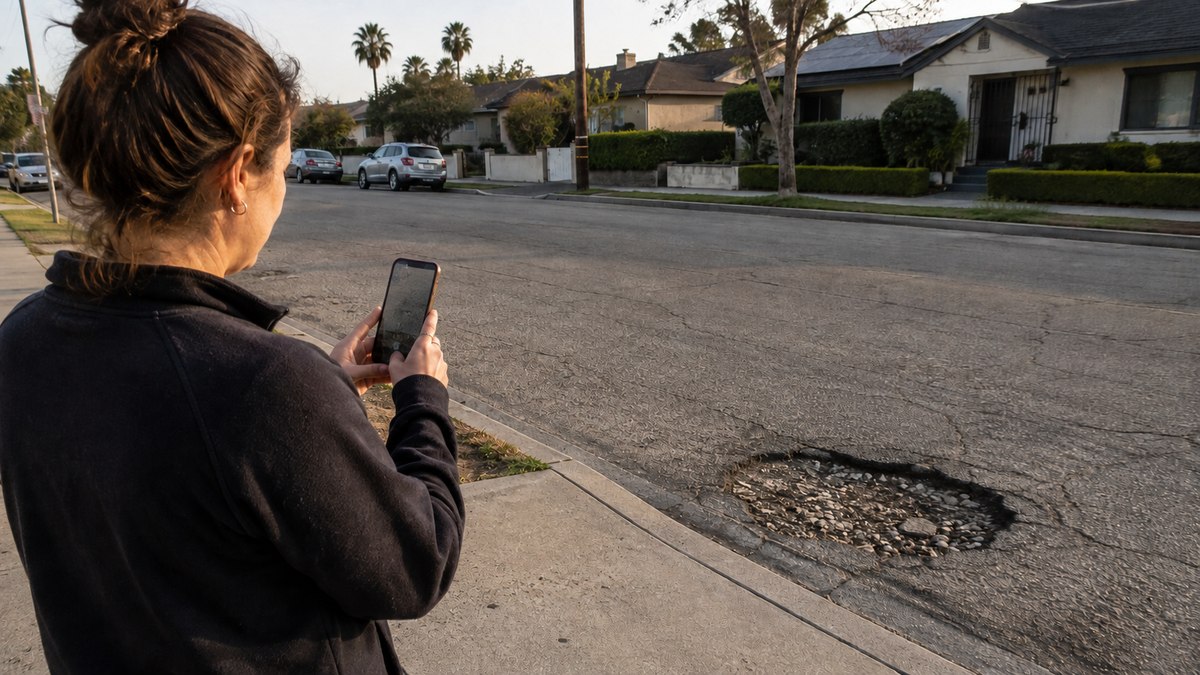
- Point the camera at the pothole. Stand a few feet back so the whole hole and a bit of the surrounding asphalt are in frame. Daylight helps; a streetlight is usually enough at night. On a LiDAR iPhone, keep the phone reasonably steady for a moment so it can read the depth.
- Press and hold, and say what you see. "There's a pothole in the right lane in front of 4th and Main." Plain language is exactly right. You don't need a department name, a request category, or a form field, and you don't need to spell the address.
- Confirm the freeze-frame. CLARK AI frames what it found and asks something like "I saw a pothole. Should I submit this?" If it framed the wrong thing, retake. If it's right, confirm, and CLARK AI sends it automatically.
- Watch the tracker. Your report gets a Tea For Streets ID and a status line: Received, then On It when the city has opened a work order or is actively handling it, then Resolved when the city reports a terminal outcome. You'll also collect Street Cred, with a bonus for potholes.
From "Hey Siri" to "Sent" is about eight seconds. All the work a 311 form normally pushes onto you is done by the app, then checked by a person before anything reaches the city.
What happens after you send it
Every report passes a human review before it is filed. A person at Tea For Streets looks at the photo, the measurement, and the location, and confirms the pothole is real and on a public road. No unreviewed AI output reaches a city system.
The report is then filed into MyLA311, the city's request system, where potholes route to StreetsLA (the Bureau of Street Services). StreetsLA's documented service level for potholes is three business days, and the City Controller found that 92% of 19,252 pothole requests in one audited year were closed within that window. CLARK AI checks the case as the city updates it and moves your status line accordingly.
Two things worth knowing. First, the filing is anonymous to the city: it carries the issue, the location, and the photo, not your name or email. Second, "Resolved" means the city reported a terminal outcome: closed, cancelled, duplicate, or referred, not necessarily that a crew has been out with a truck.