Tea For Streets
The short version
- Los Angeles defines graffiti by whether it was authorized, not by whether someone considers it art.
- Residents can report graffiti through MyLA311, 311, or use CLARK AI by Tea For Streets to document and track a street issue.
- The City's Office of Community Beautification uses community-based contractors to provide graffiti-removal services.
- Los Angeles has historically tracked how many graffiti requests are completed within 24 and 48 hours.
- In early 2026, City officials reported that the percentage of requests addressed within 24 hours had fallen significantly.
- Graffiti shows why submitting a city-service request and actually resolving one are two different problems.
First, what counts as graffiti?
Los Angeles Municipal Code defines graffiti as an unauthorized inscription, word, figure, or design placed on public or private property.1
The important word is unauthorized.
That means the distinction between a mural and graffiti is not simply whether the work is colorful, artistic, large, small, beautiful, or ugly.
Permission matters.
Los Angeles has a long history of public murals and street art. Graffiti is treated differently when someone marks property without authorization.
That distinction matters because graffiti removal is not really a debate about whether cities should erase art.
It is a property-maintenance and public-realm issue.
How do residents report graffiti?
For residents, one of the main entry points is MyLA311.
Graffiti removal is among the services residents can request through the City's 311 system. Once submitted, requests are assigned based on the type of service being requested. The City notes that completion times vary depending on the request, its priority, and the volume being handled by the responsible department.2
Residents can also use CLARK AI by Tea For Streets to document graffiti and other street issues.
With CLARK, a resident can capture the issue, create a structured report, identify where it should be sent, and track the status of the report after submission.
The distinction is important.
311 is the City's service-request system.
CLARK is designed to help residents move from seeing a problem to documenting it clearly, routing it correctly, and following what happens next.
Who removes graffiti in Los Angeles?
Behind those requests is the Los Angeles Board of Public Works' Office of Community Beautification, or OCB.
OCB operates a citywide anti-graffiti and anti-litter program and contracts with nonprofit, community-based organizations to perform graffiti-removal work.3
And crews do not only wait for 311 requests.
City reports say graffiti contractors also patrol major corridors and known graffiti hotspots within their service areas looking for conditions that need attention.3
In other words, graffiti removal in Los Angeles is both reactive and proactive.
Someone may report a tag.
Or a crew may find it first.
Los Angeles removes graffiti at a massive scale
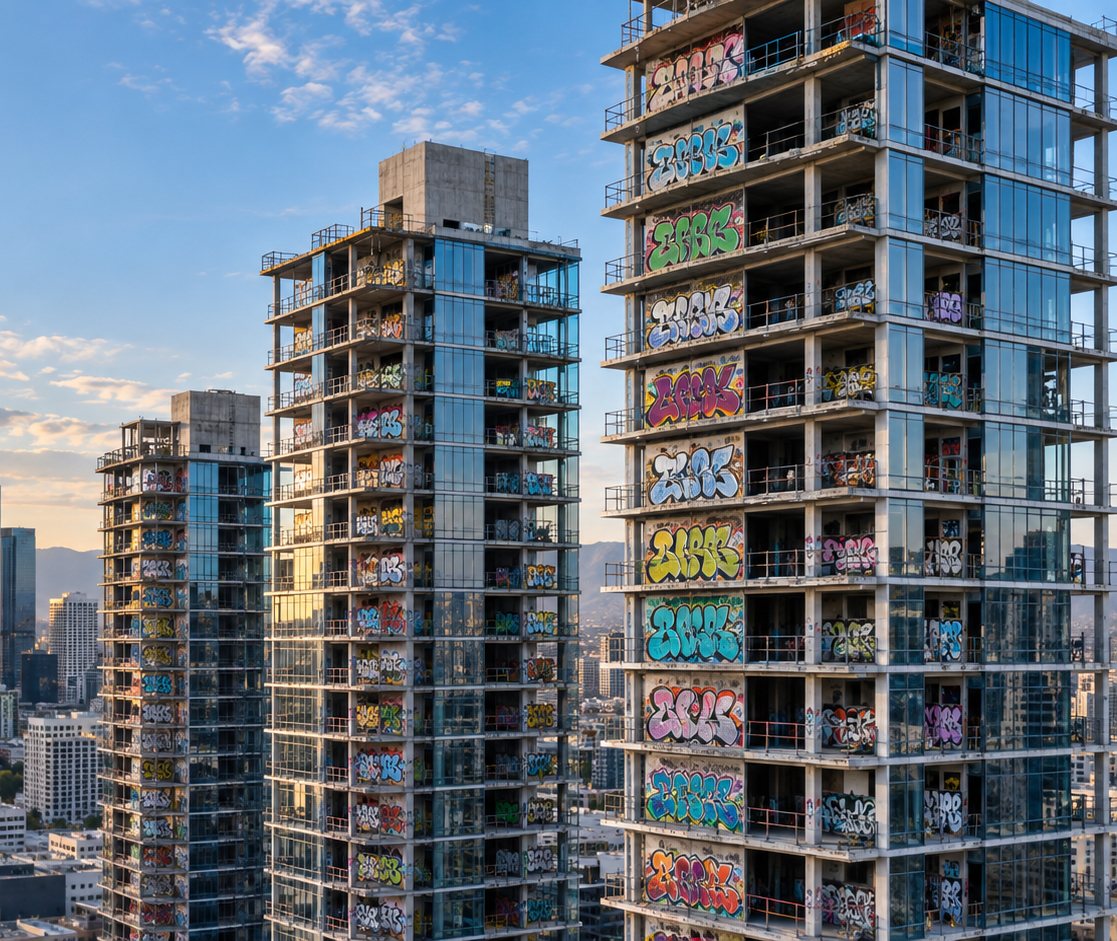
The numbers show how much work is involved.
In earlier reporting, the Department of Public Works documented hundreds of thousands of locations where graffiti was removed in a single fiscal year and tens of millions of square feet of graffiti removal.3
That scale changes the way the issue should be understood.
One piece of graffiti may look like a small maintenance problem.
Multiply that across hundreds of neighborhoods, commercial corridors, freeway-adjacent properties, utility infrastructure, alleys, public buildings, and private property, and graffiti removal becomes a significant city operation.
Which creates another problem:
How do you decide what gets handled first?
Response time has become part of the conversation
Los Angeles measures how quickly graffiti-removal requests are completed.
According to a February 2026 City Council motion, the Office of Community Beautification completed 65% of graffiti-removal requests within 24 hours in FY 2023-24.
That number fell to 62% in FY 2024-25.
By the time the motion was introduced in February 2026, officials reported that the 24-hour figure had dropped to approximately 36% of requests during the current fiscal year.4
The Council subsequently asked the Office of Community Beautification to report on contractor performance, geographic coverage, staffing, 311 request volume by Council District, repeatedly targeted locations, and how graffiti requests are prioritized.4
The issue also reached the City's budget process.
During adoption of the FY 2026-27 budget, the Council approved an additional $1.683 million in contractual-services funding to maintain graffiti-abatement service levels and directed the Board of Public Works to continue examining how requests are prioritized.5
Those decisions reveal something that is easy to miss when tapping "submit" on a phone:
A service request is not the same thing as service capacity.
The reporting technology may work perfectly while the operation behind it is overloaded.
Does graffiti cause crime?
Graffiti is often discussed alongside the "broken windows" theory, the idea that visible signs of disorder can encourage more disorder and eventually more serious crime.
The research is more complicated than the slogan.
A major meta-analysis examining 96 studies found no consistent evidence that neighborhood disorder itself causes greater aggression or more negative attitudes toward a neighborhood. Researchers have also found that establishing a direct causal relationship between disorder and crime remains difficult.6
So it would be an oversimplification to say:
Graffiti appears, therefore crime increases.
But cities do not need that claim to explain why graffiti matters.
Unauthorized graffiti damages property. Residents and businesses report it. Cities spend money removing it. Crews spend time responding to it. Frequently targeted locations may require repeated service.
And people notice whether the public spaces around them are maintained.
That alone makes graffiti an infrastructure and operations issue.
The hardest part may be closing the loop
For a resident, the process often begins with three basic pieces of information:
- What is it?
- Where is it?
- What does it look like?
A photo, location, and issue type can turn something someone notices on a walk into an actionable service request.
But after submission come different questions.
Was the report routed correctly?
Was someone assigned to it?
Was the graffiti actually removed?
How long did it take?
Was the request closed because the work was completed, or simply because it moved through an administrative system?
Those questions apply to far more than graffiti.
They also apply to potholes, illegal dumping, damaged sidewalks, broken streetlights, and other everyday conditions residents encounter.
The future of civic reporting is not just making it easier to tell a city that something is wrong.
It is making it easier to understand what happened afterward.
That is where tools like CLARK AI become useful: not as a replacement for city systems, but as a way to help residents create clearer reports and follow the life of an issue from submission through resolution.
Because noticing the problem is only step one.
The real measure is whether the loop gets closed.