BIDs & public realm · 6 min read

How much does the street outside shape a hotel guest’s stay?

A guest’s stay starts at the curb. The hotel does not own the sidewalk, the streetlight, or the crossing; the City does. What a hotel can own is the record of what was reported and what happened next.

Safir Wazed
Contributor: Safir Wazed
Published Oct 4, 2026
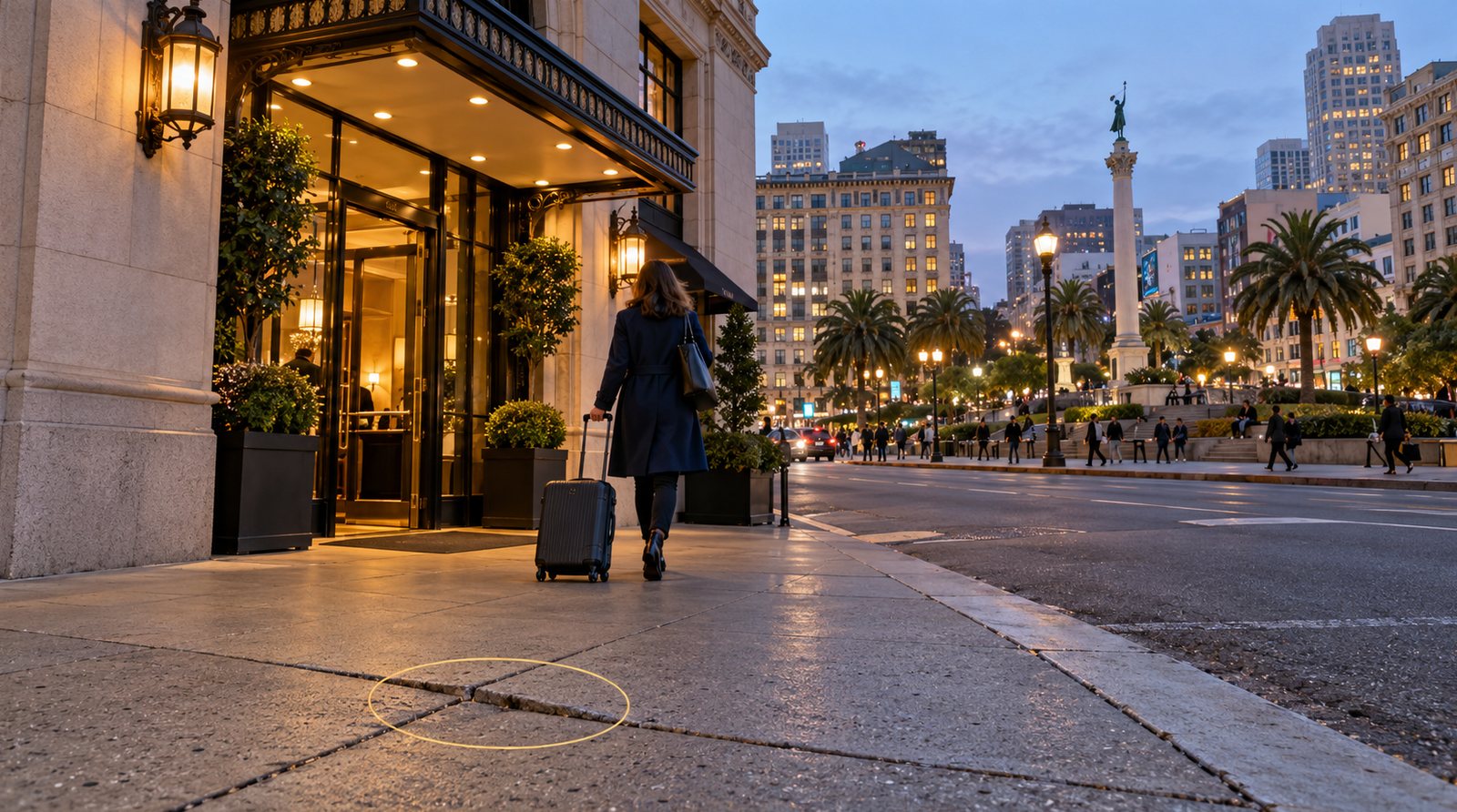
A guest with a rolling suitcase walks toward a hotel entrance on Union Square in San Francisco at dusk, with a gold measurement ring around a cracked sidewalk joint in the foreground
Union Square, San Francisco, where the hotel conversations started. The visuals here are concepts. The pattern is not.
76%
Reviews that cite location
The most-cited theme across 82 TripAdvisor reviews of one Chicago apartment-hotel. Guests described the blocks they walked, not the distance to downtown.
49.5M
Visitors to Los Angeles in 2025
$42.6 billion in local business sales, per LA Tourism and Tourism Economics. Super Bowl LXI and the 2028 Games are next.
2days
Median for dumped trash we filed
From filing to a City closure, 2.1 days across 12 cases. Potholes 5.5 days, graffiti 14.7, as of October 3, 2026.
0 of 5
Our sidewalk cases resolved
Filed August 15, 2026. As of October 3 all five still sit at Reported, seven weeks on, with no completion service level.
The short answer

More than the lobby does. A guest’s stay starts at the curb: the sidewalk from the rideshare drop-off, the streetlight on the walk back from dinner, the trash by the loading dock, the crossing to the convention center. The hotel does not own any of it. The City does. What a hotel can own is the record: what is broken, when it was reported, and what the City did about it. That is what Tea For Streets built CLARK AI to hold.

The short version

What guests notice

From the reviews, not the brochure
Location
76 percent of reviews at one hotel cite it, described as the blocks guests walked, not the distance to downtown.
Cleanliness and security
The top three drivers of a positive stay in AHLA’s 2025 report. Guests do not stop counting at the property line.
Street noise
15 of 82 reviews at the same hotel. Guests write about the block and file it under “location.”
The arrival
The curb is the first and the last thing a guest sees.

Who owns it

Three answers, no shared record
Roadway and curb
The City, reached through official 311 channels.
The sidewalk
The fronting owner by law; the City repairs under a 30-year settlement with no completion service level.
The district
A BID, where there is one. The City of Los Angeles has 43.
The record
Nobody, until the hotel keeps it.
  • The audience: Los Angeles hosted 49.5 million visitors in 2025 and is heading into Super Bowl LXI and the 2028 Games. The arrival experience is now a regional selling point.
  • The move: a hotel cannot fix the block. It can document it, file it, and track it to a City outcome. That record is worth more than a complaint.

What do guests actually say about the street?

Read the reviews, not the brochure. When Experiential Capital Group analyzed every TripAdvisor review for a Chicago apartment-hotel, 82 reviews across three years, location was the most-cited theme at 76 percent, and guests described it as a place they walked: the retail corridor, the park, the lakefront trail. Street noise showed up in 15 of the 82 reviews. Guests write about the block. They just file it under “location.”

Cleanliness is the other half. The American Hotel & Lodging Association’s 2025 State of the Industry report ranks guest room cleanliness, property cleanliness, and security measures as the top three drivers of a positive stay. Those categories stop at the property line. But nobody separates the lobby floor from the sidewalk they crossed to reach it, and “security” to a guest includes the streetlight outside. A guest who steps over a dumped mattress at the porte-cochère has already decided something about the property.

None of this is a hotel’s fault. It is the hotel’s problem.

The distinction matters because it changes what a general manager can do about it.

Who actually owns the block outside a hotel?

In Los Angeles, three different answers, and a guest never sees the seams.

01

The roadway and the curb

the City, through 311

Potholes go to StreetsLA, the Bureau of Street Services, with a service level of three business days. Graffiti goes to the Office of Community Beautification, with a goal of removal within a week. Bulky items and illegal dumping go to LA Sanitation. All of it is reached through official 311 channels, and the City accepts a report from any resident or business.

02

The sidewalk

the complicated one

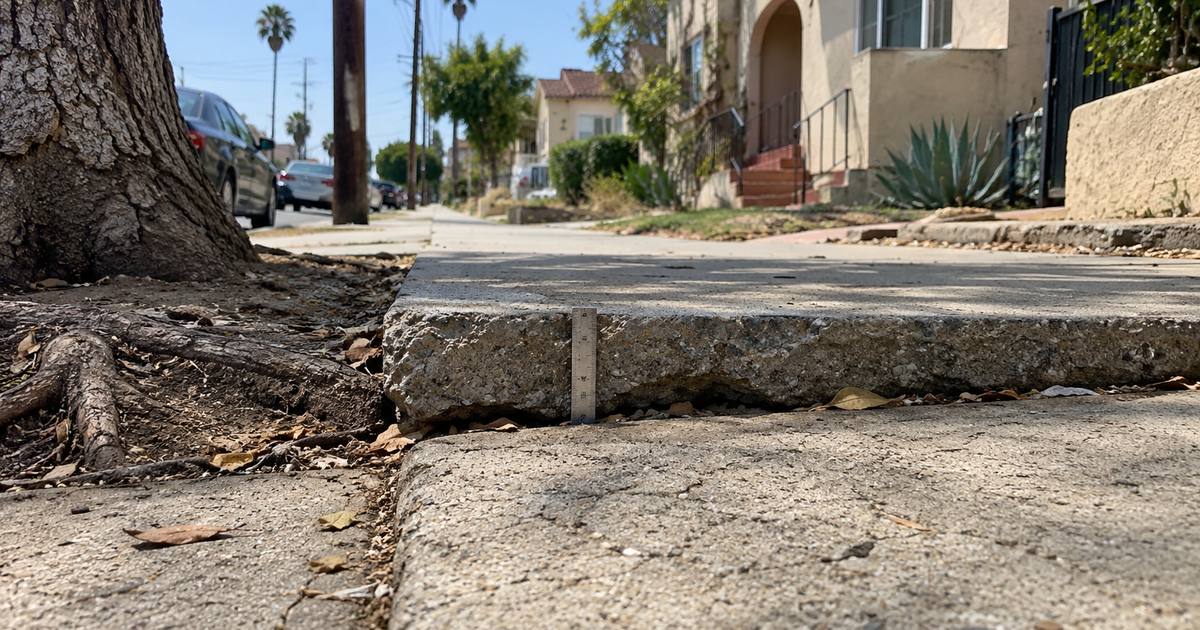
California Streets and Highways Code section 5610 and Los Angeles Municipal Code section 62.104 put sidewalk maintenance on the fronting property owner. The City has largely not enforced that against homeowners, and after the Willits ADA settlement it committed about $1.4 billion over 30 years to repairs. Investing in Place counted more than 50,000 broken sidewalks citywide in 2025, and the City Controller found in 2021 that at the pace then reported the backlog would take about 500 years. A sidewalk request enters a queue with no completion service level. See Why do sidewalk repairs in Los Angeles take so much longer than potholes?

03

The district

where there is one

Hotels in downtown Los Angeles, Hollywood, and Santa Monica typically sit inside a Business Improvement District that pays for cleaning and ambassador crews on top of City service. The City of Los Angeles alone has 43 BIDs collecting about $65 million a year, and a BID renews only if property owners can see what they got for it. See What is a Business Improvement District?

A guest experiences one block. A hotel that wants to change that block is dealing with the City, the property line, and the district at once, with no shared record among the three.
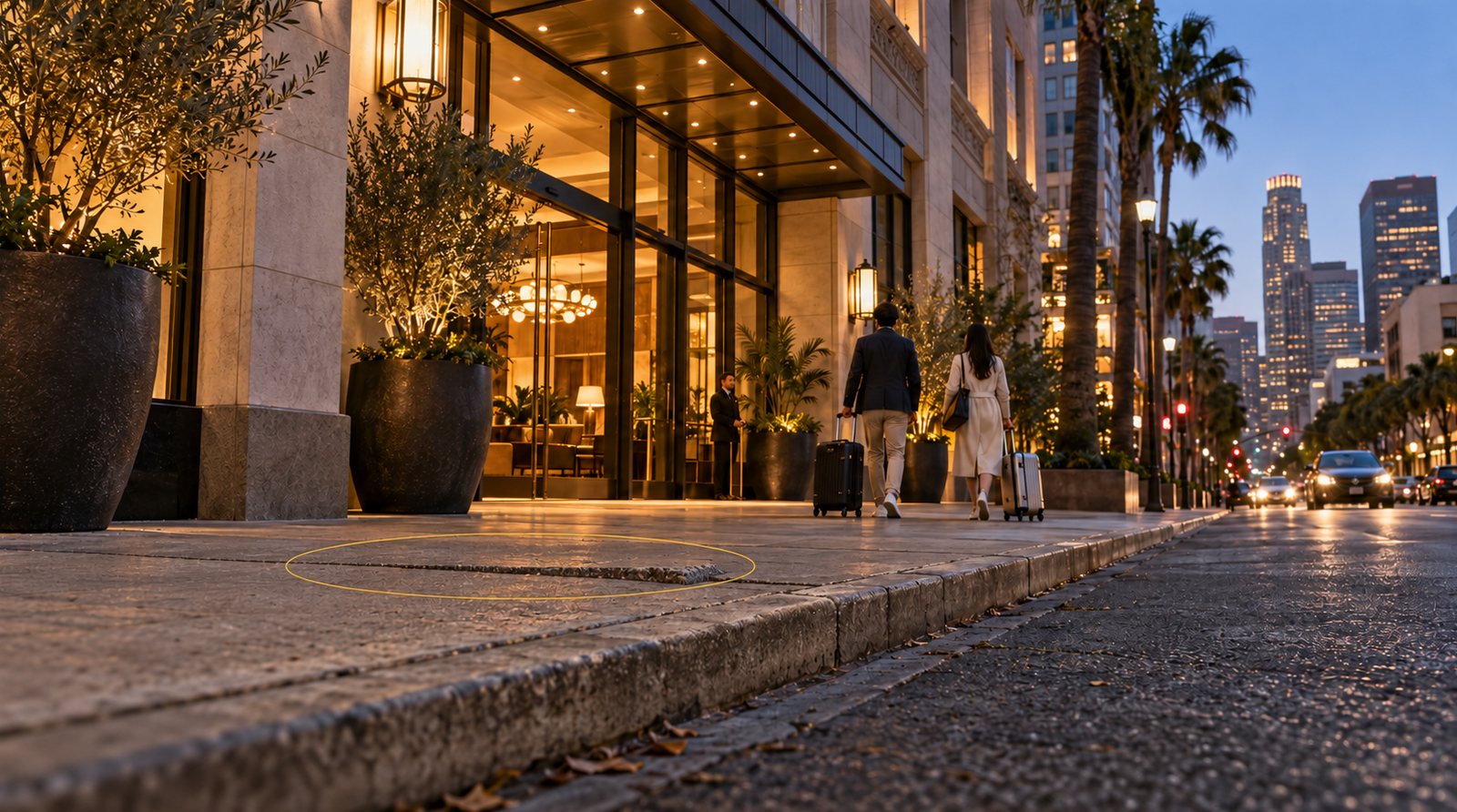
Two guests with suitcases pass a downtown Los Angeles hotel entrance at dusk; a gold measurement ring marks a lifted sidewalk slab beside the curb
Downtown Los Angeles. A lifted slab at the curb is the first thing a guest meets. The visuals here are concepts. The pattern is not.

What can a hotel do about a street it does not own?

Measure it, report it, and track it. In that order.

  1. STEP 01

    Walk the arrival radius.

    Not the whole neighborhood. The quarter mile a guest actually covers: the drop-off, the nearest transit stop, the route to the convention center or the stadium shuttle, the three restaurants the front desk recommends. Photograph every condition with a location and a date.

  2. STEP 02

    File each one through official 311 channels.

    One condition per report. A raised sidewalk edge, a dark streetlight, a dumped item, a pothole at the valet ramp. Filing is free and the City accepts it from any resident or business.

  3. STEP 03

    Keep the case reference and the status.

    Received, then active handling, then a City-reported closure. Closure is not the same as repaired; someone has to go back and look. See What does “Closed - See Comments” mean on a MyLA311 request?

  4. STEP 04

    Bring the record to the people who can move it.

    A council office, a BID executive director, a Bureau of Engineering sidewalk program manager. Not a complaint, a dated list: filed, handled, closed, verified, still open.

The last step is the one that works. In our experience an office responds to “twelve conditions filed on this block, nine closed, three open past 30 days, here are the case numbers” in a way it never responds to “our guests keep complaining.”

If you run a hotel, a hotel group, or a Business Improvement District and want the arrival radius around one property documented and filed, email us. The first walk is on us.
Field notes · Tea For Streets

Spill the Tea

93Cases filed through official 311 channels, as of Oct 3, 2026
70Closed by the City; 13 more cancelled, 10 still open
23App-filed closures that came back with the repair described; 12 closed with no comment

We have spent a good part of 2025 and 2026 walking San Francisco’s Union Square and calling on hotel districts in Los Angeles, talking with general managers and directors of rooms about the block outside their doors. The pattern was the same in both cities. Every GM knew exactly which slab of sidewalk trips guests and which corner goes dark at night. Almost none had filed a report, and the ones who had could not tell us what happened to it. The problem was not caring. It was that nobody on a hotel staff has “track the city” in their job description.

So we tested the loop ourselves. As of October 3, 2026, Tea For Streets had filed 93 cases into the City of Los Angeles through official 311 channels, 50 of them through the CLARK AI app and the rest by our field team. The City has closed 70. Of the 40 app-filed cases with a terminal outcome, 23 came back with the repair described, 12 came back closed with no comment at all, and 5 closed without a fix. Closed is not the same as repaired, so the 12 silent closures are the ones we go back and look at. Dumped trash closed in a median of 2.1 days, potholes in 5.5, graffiti in 14.7. Those are usable numbers for a hotel. A dumped mattress at the loading dock is a two-day problem if someone files it.

Sidewalks are the honest exception. Our five sidewalk cases, filed August 15: zero resolved, all five still sitting at Reported seven weeks later, with replies that amounted to “received and filed for future reference.” That is not the City ignoring hotels. Sidewalks sit in a different bureau under a 30-year court settlement with no completion service level. A hotel that files a sidewalk report is building a record, not ordering a repair. The record still matters: it is what a BID or a council office needs to move a block up the list, and it is what a risk manager wants on file if a guest falls.

One more thing we learned. Guests do not distinguish between the hotel and the block, and the City does not distinguish between a hotel and a resident. Both of those are usable. The visuals in our hotel demos are concepts. The pattern is not.

FAQ

Can a hotel file 311 reports, or only residents?

+
Any person or business can file a service request with the City of Los Angeles. There is no residency requirement. A hotel can file for conditions on the public right of way around its property.

Who is liable if a guest trips on the sidewalk outside a hotel?

+
It depends on the facts. California law puts sidewalk maintenance on the fronting owner, and California Government Code section 835 covers dangerous conditions of public property. A dated record showing the condition was reported, and when, is useful to everyone involved. Talk to counsel; this is not legal advice.

Does a Business Improvement District replace 311?

+
No. BID crews clean and report; the City still repairs. A BID that files and tracks its own 311 cases can show property owners what it delivered, which is exactly what it needs at renewal.

How is this different from the hotel’s own maintenance log?

+
The hotel log covers the property line inward. Everything outside it belongs to the City or the fronting owner, and the only record of what the City did is the 311 case history. CLARK AI keeps that history in one place, by location, with photos and dates.

Does CLARK AI fix the street?

+
No. It documents the condition, files it through official 311 channels after human review, and tracks what the City does. The City repairs. Closed means the City said so; verified fixed means someone went back and photographed the repair.

Do the World Cup and LA28 change any of this?

+
They change the audience. Santa Monica hotels saw average daily rates rise 42 percent on World Cup match days in 2026, about twelve miles from the stadium. The 2028 Games will put millions of first-time visitors on foot around venues and hotel districts. The block outside will be the first and last thing they see.
CLARK AI by Tea For Streets
Report what you see.
Free to report, right from your iPhone.
Download on the App Store
  1. Experiential Capital Group via Hospitality Net, What 82 TripAdvisor Reviews Reveal About The Neighborhood Hotel Lincoln Park, Apr. 18, 2026: location cited in 76 percent of 82 reviews, described as the neighborhood guests walked; street noise in 15 reviews.
  2. American Hotel & Lodging Association, 2025 State of the Industry report, as summarized by GoAudits, Guest Experience in Hotels, Apr. 21, 2025: guest room cleanliness, property cleanliness, and security measures as the top factors in a positive stay.
  3. Santa Monica Daily Press, Los Angeles Tourism Generated $42.6 Billion in 2025, Aug. 3, 2026, citing the Los Angeles Tourism & Convention Board, Tourism Economics, and Santa Monica Travel & Tourism: 49.5 million visitors; Santa Monica average daily rates up 42.1 percent on World Cup match days, about 12 miles from the stadium.
  4. Los Angeles City Controller, Repairing L.A.’s Broken Sidewalk Strategy, Nov. 2021: StreetsLA pothole service level of three business days; no completion service level for sidewalk repair; the pace of the backlog.
  5. Los Angeles Office of Community Beautification, Graffiti Abatement: goal of removing reported graffiti within a week.
  6. Donald Shoup, The City of Broken Sidewalks, Planetizen, Dec. 5, 2024: about $1.4 billion over 30 years under the Willits settlement; the Controller’s 500-year estimate; the text of LAMC section 62.104.
  7. Investing in Place, A City that Works, July 2025: more than 50,000 broken sidewalks citywide.
  8. California Streets and Highways Code section 5610; Los Angeles Municipal Code section 62.104; California Government Code section 835.
  9. Los Angeles Office of the City Clerk, About BIDs and the BID Division overview: 38 property-based and 5 merchant-based districts; about $65 million a year in assessments.
  10. Tea For Streets production data, pulled read-only from the production database on October 3, 2026: 93 cases filed through official 311 channels (50 through the CLARK AI app, 43 by the field team); 70 closed by the City; closure categories and median times by type; five sidewalk cases filed August 15, 2026.