How 311 works · 9 min read

Why do sidewalk repairs in Los Angeles take so much longer than potholes?

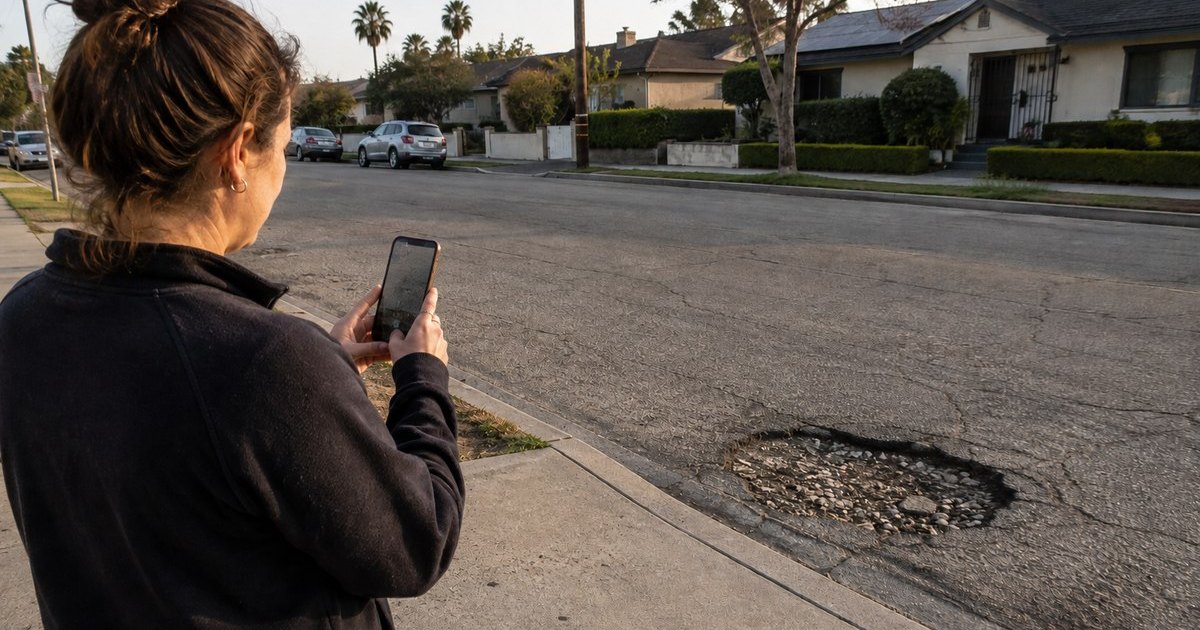
A pothole is a maintenance task with a three business day service level. A sidewalk is a construction job inside a $1.37 billion ADA settlement, with a 4,400 request backlog and a property owner duty attached.

Safir Wazed
Contributor: Safir Wazed
Published Sep 10, 2026
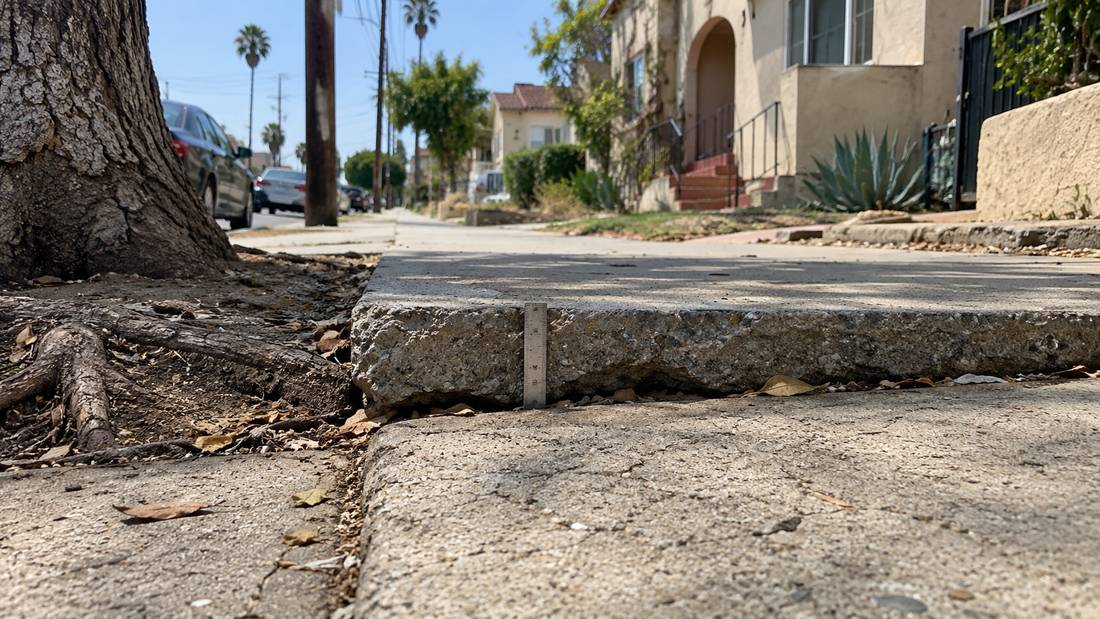
A sidewalk panel lifted by a tree root on a Los Angeles residential street, with a steel ruler standing against the raised edge
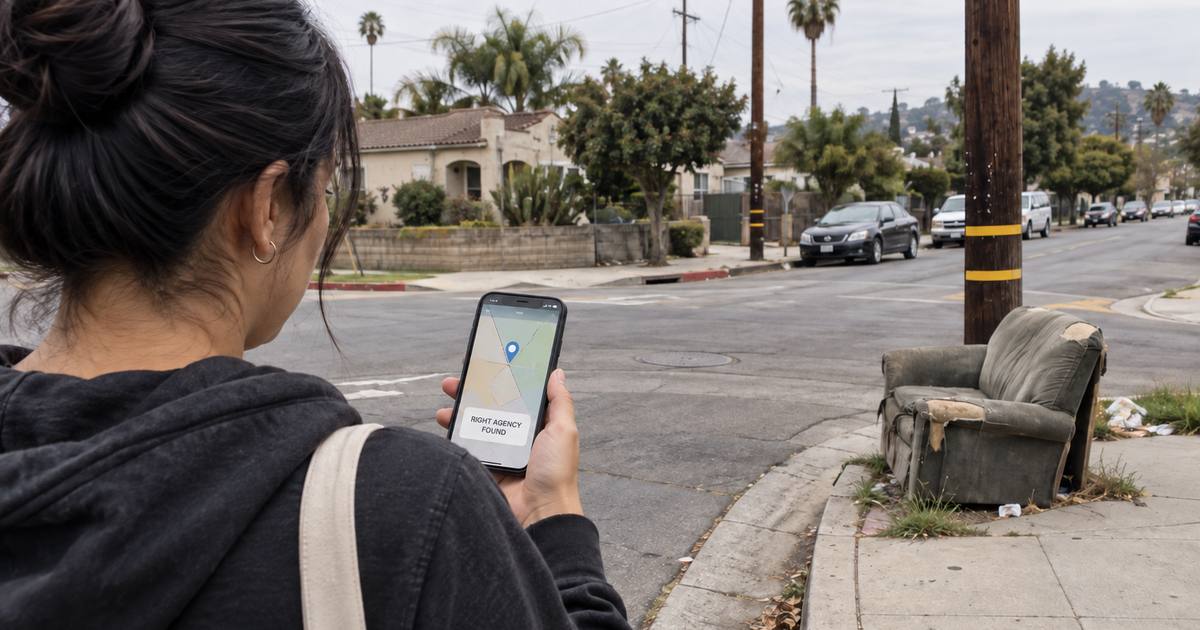
The visuals here are concepts. The pattern is not.
3days
Pothole service level
StreetsLA closed 92% of 19,252 requests inside it in FY2021.
41days
Sidewalk asphalt patch
Average in FY2021, 24 at the median. The permanent fix has no published service level.
4,400+
Requests waiting
Sidewalk repair backlog at the settlement's tenth anniversary, August 2026.
¼inch
The legal line
A vertical uplift above a quarter inch is an ADA barrier. A photo cannot show it.
The short answer

Because a pothole is a maintenance task and a sidewalk is a construction project with a civil rights settlement attached. A pothole goes to StreetsLA, which has crews, a three business day service level, and no question about who pays. A broken sidewalk enters the Bureau of Engineering's Sidewalk Repair Program, a 30 year, $1.37 billion effort created by an Americans with Disabilities Act settlement, where more than 4,400 requests are waiting and California law puts routine maintenance on the fronting property owner.

The short version

A pothole

Maintenance task
Who fixes it
StreetsLA crews, with hot mix and a truck.
Service level
Three business days. 92% of 19,252 requests met it in FY2021.
Who pays
The City. The roadway is City property.
Legal frame
Routine maintenance.
Our cases, Sep 2, 2026
40 filed, 80% resolved, median City closure five days.

A sidewalk

Construction project
Who fixes it
Bureau of Engineering's Sidewalk Repair Program for the permanent repair. StreetsLA lays temporary asphalt.
Service level
None published. Asphalt patches took 41 days on average, 24 at the median, in FY2021.
Who pays
The fronting owner, after one City repair under fix and release. City spend capped at $20,000 per lot.
Legal frame
Willits v. City of Los Angeles, $1.37 billion over 30 years, plus Streets and Highways Code 5610.
Our cases, Sep 2, 2026
5 filed, 0 resolved, all open past 18 days.

Who owns a sidewalk repair in Los Angeles?

Start with the law. California Streets and Highways Code section 5610 says the owner of a lot fronting a public street must maintain the sidewalk so it does not endanger people or property. Los Angeles wrote the same duty into its municipal code, section 62.104, and added the words "or violate the Americans with Disabilities Act." A pothole sits in a roadway the City owns and maintains outright. The sidewalk in front of your house is yours to maintain and the City's to answer for: the Controller counted more than 1,700 claims and 1,020 lawsuits for sidewalk injuries over five fiscal years, with more than $35 million paid.

The owner holds the duty. The City carries most of the liability. That split is the first reason nothing about a sidewalk is simple.

Then the settlement. In 2010, disability rights advocates and three residents with mobility disabilities sued the City over sidewalks and curb ramps that wheelchair users could not use. Willits v. City of Los Angeles was settled and finalized in 2016: the City committed at least $1.37 billion over 30 years to fix sidewalks, curb ramps, and other barriers in the pedestrian right of way, the largest disability access settlement in the country at the time, for an estimated class of 280,000 Angelenos with mobility disabilities. The Sidewalk Repair Program launched in December 2016. With it came the fix and release policy: the City makes the first repair, issues a Certificate of Sidewalk Compliance, guarantees one warranty repair for 20 years on residential property or 5 years on commercial and industrial property, caps its own spend at $20,000 per lot (inflation adjusted), and after that can enforce the owner's duty to maintain.

StreetsLA sits alongside this program, not inside it. It lays temporary asphalt over the worst uplifts and, per the Controller, has no program with resources dedicated to routine sidewalk maintenance.

The quarter inch that changes everything

This is where the ADA enters the timeline. A pothole is fixed when the hole is filled. A sidewalk repair that counts toward the settlement has to meet federal accessibility standards, and the City publishes the list it inspects against: an uplift greater than a quarter inch, a sidewalk narrower than four feet, a cross slope steeper than 2 percent, a gap or grate opening wider than half an inch, and root heave that breaks the running grade. Those numbers come from the 2010 ADA Standards and the federal guidelines for public rights of way. A crew with hot mix cannot meet them. Concrete comes out and goes back in under permit, to the City's standard plan, often after an arborist decides what happens to the tree that lifted it. City policy replaces every street tree it removes with two.

And the City goes further than the standard requires. The Controller's 2021 audit found that neither the ADA nor the settlement requires the City to rebuild the entire sidewalk on a parcel when only small defects exist in a few spots. The Ninth Circuit put sidewalks under the ADA in Barden v. Sacramento in 2002, and in that same case the Justice Department told the courts that the ADA's "program access" standard for existing sidewalks does not require a city to replace them wholesale. The fix and release policy assesses the whole parcel anyway, so each certificate becomes a small construction project. The audit recommended focusing on significant defects instead, the way New York, Sacramento, Portland, and Seattle do. That is not neglect. It is a policy choice that trades speed for completeness, made by a city trying to end a decade of litigation.

One example from the audit shows where the time goes. A City owned corner parking lot took 460 days from assessment to finished sidewalk. Design took about 30 days and construction about 65. The rest was property access agreements, public contracting, and street trees.

Why is the queue so long?

Scale. Los Angeles has more than 9,000 miles of sidewalk, about 11 square miles of concrete, across roughly 640,000 parcels. By mid 2021 the City had completed repairs at about 2,100 sites and issued 4,879 certificates of compliance, less than one percent of parcels. NBC4's I-Team did the arithmetic on the audit: at that pace, nearly 500 years. Separately, more than 50,000 sidewalk problem reports over six years sat outside the settlement work entirely, because ordinary maintenance is not what the program funds. As of the settlement's tenth anniversary in August 2026, the City reports more than $370 million spent and a backlog of more than 4,400 requests.

Priority. The program exists to satisfy an accessibility settlement, so it starts where the law starts: with people who cannot use the sidewalk at all. The City's stated first priority is Access Requests, filed by or for a person with a mobility disability. Within those, the top of the list is residential locations within 500 feet of transit that have been waiting more than 120 days. Then come the roughly 2,700 City facilities the department has identified. An ordinary uplift on an ordinary block, reported by someone who can step over it, is at the back.
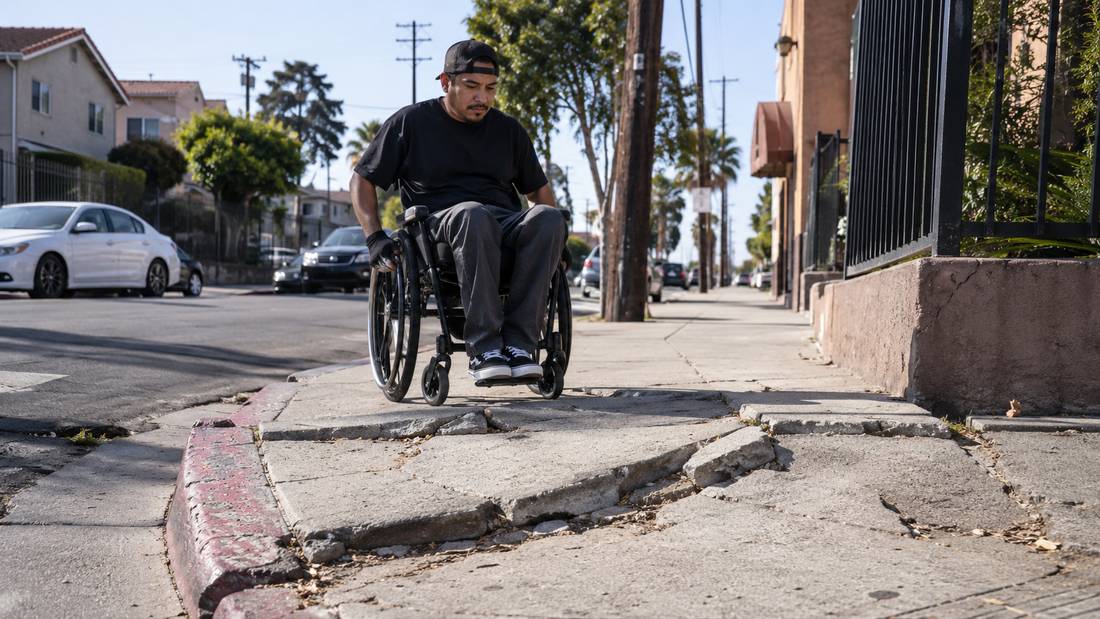
A man in a wheelchair stopped at a broken, uplifted sidewalk corner on a Los Angeles residential street
Access Requests, filed by or for a person with a mobility disability, are the only lane with a stated priority.

Money. Funding is set each year by the City Council, and the bureau that does the temporary patching lost $61 million, 26 percent of its operating budget, between FY2024 and FY2026. The owner rebate program is waitlisted: applicants go on the list when every available dollar has been reserved. By June 2021 the City had issued 538 rebate checks against 4,451 applications.

What happens when you report a sidewalk through 311?

Your request lands in the City's 311 system like any other, then splits. For an immediate hazard, StreetsLA may lay a temporary asphalt patch; in FY2021 those took 41 days on average and 24 at the median. The permanent repair is logged with the Sidewalk Repair Program, which tells residents plainly that requests far exceed available resources and repairs may not happen right away. There is no published service level for completing an ordinary sidewalk repair, which is itself the answer to the question in the title.

We know because we went through that door. Sidewalk became a reportable issue type in CLARK AI by Tea For Streets in August 2026. In the second half of that month we filed five sidewalk reports through official 311 channels, each one checked by a person and filed the same way as our potholes. Each was accepted. Each came back with the same seven words: "received and filed for future reference." That is an honest description of a place in a backlog. It is not a work order.

Report it anyway. A filed request records what the City knew and when, which matters under California Government Code section 835, the statute that makes a public entity liable for a dangerous condition it had notice of and did not fix. If a member of your household has a mobility disability, file an Access Request instead of a general report; it is the only lane with a stated priority. And file with a measurement, not just a photo. A quarter inch is the legal line, and a photo cannot show it. Note the height of the lip in the description so the report carries a number.
Field notes · Tea For Streets

Spill the Tea

83Cases filed through 311, as of Sep 2, 2026
80%Potholes resolved, median five days
0 of 5Sidewalks resolved, all open past 18 days

Same system, same filing quality, a completely different outcome. Graffiti: 32 cases, 84 percent, ten days. Trash: six cases, 100 percent, 44 hours. "Resolved" means a City reported terminal outcome, not our own verification of the repair.

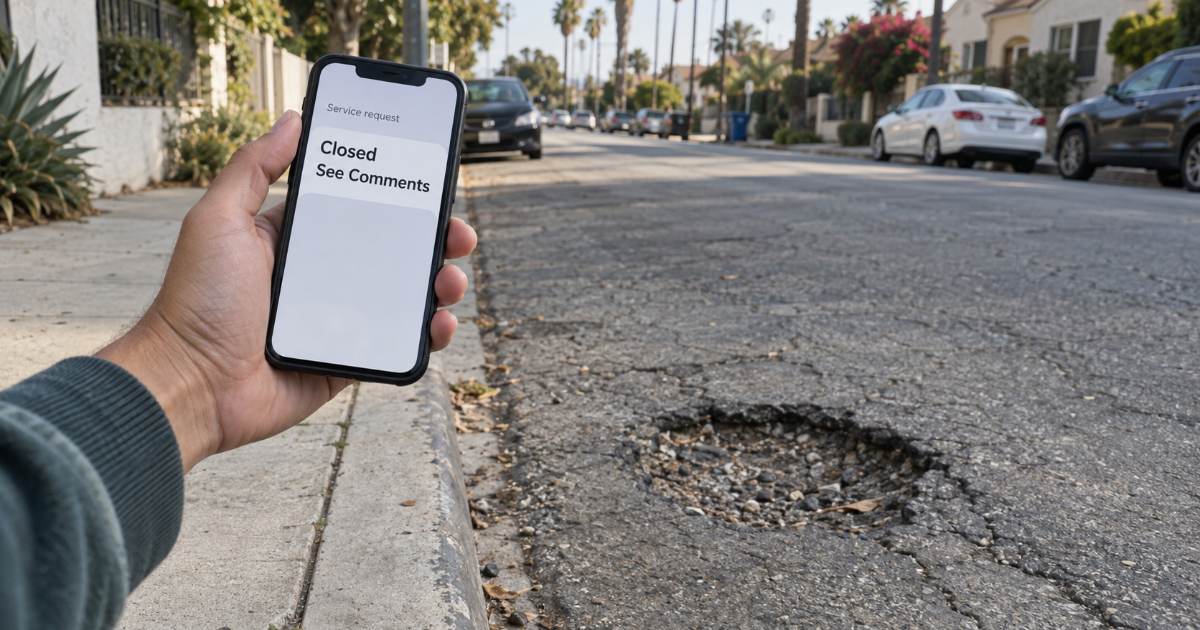
We do not read that as a failing crew. We read it as a missing workflow, visible only because we track outcomes rather than submissions. The pothole program has a service level and a truck. The sidewalk program has a settlement, a permit process, and a queue. See what a closure actually tells you in What does "Closed - See Comments" mean on a MyLA311 request?

Here is the part nobody explains. Sidewalk programs produce complaints, not measurements. The Controller wrote that the City "does not know how many sidewalk locations need repair," and that a full survey was priced in 2012 at well over $10 million and two to three years, then shelved. Seattle assessed all 2,336 miles of its sidewalks for $400,000 in 15 months with engineering interns and tablets. Caltrans's own research division spent 2024 and 2025 piloting LiDAR to inventory sidewalks and check ADA compliance, after a survey of all 50 state transportation departments found no consistent way to assess sidewalk accessibility at all. The gap is not concrete. It is data. The cheapest instrument for closing it is the phone already in a resident's pocket, and we say plainly that a person reviews every report before anything is filed.

The gap has a price. The 2021 audit counted more than $35 million paid on sidewalk injury claims over five fiscal years, $12 million of it in FY2020 alone. Controller Galperin's summary to NBC4 at the time: about $30 million a year on sidewalk repair, $12 million in a single year on settlements. The Controller's office now puts sidewalk related liability at $110 million between July 2019 and December 2025, about one dollar in ten of everything the City pays out. A city spending $370 million to fix sidewalks and $110 million because it has not is the clearest case for measured street data we know of.

Vehicles do not see sidewalks. Dashcam and robotaxi feeds now hand cities pothole data, but nothing on wheels measures a quarter inch uplift, so resident reports are the only sidewalk signal most cities have. The usual limit applies: our sample is pilot scale and largely team generated. We publish it dated and keep updating it.

FAQ

Who is responsible for the sidewalk in front of my house in Los Angeles?

+
Under Streets and Highways Code section 5610 and Los Angeles Municipal Code 62.104, the fronting property owner. When the City repairs a sidewalk through the Willits program, it issues a Certificate of Sidewalk Compliance with a warranty, 20 years for residential property and 5 years for commercial and industrial property, good for one City repair. After that the maintenance duty returns to the owner.

How long does Los Angeles take to fix a sidewalk?

+
There is no published completion service level. Temporary asphalt patches took 41 days on average and 24 days at the median in FY2021. Permanent repairs sit in a backlog of more than 4,400 requests, prioritized by accessibility need rather than by date. Our five cases were all open past 18 days as of September 2, 2026, each marked "received and filed for future reference."

What counts as a sidewalk defect under the ADA?

+
The City's own list, drawn from the 2010 ADA Standards and the federal public right of way guidelines: a vertical uplift over a quarter inch, a sidewalk narrower than four feet, a cross slope over 2 percent, and a gap or grate opening over half an inch. Changes between a quarter inch and a half inch may be beveled instead of rebuilt.

Can I get a rebate for fixing my own sidewalk?

+
The City's Sidewalk Rebate Program exists but is waitlisted because of funding restrictions; new applications are queued until existing ones complete. The cap is $12,400 per lot, stump removal is rebated at $279 per stump, and the entire sidewalk fronting the property must be fully ADA compliant when the rebate is issued.

What is an Access Request, and should I file one?

+
An Access Request is a sidewalk, curb ramp, or right of way repair requested by or on behalf of a person with a mobility disability. It is the program's highest priority. If it applies to your household, use that lane instead of a general sidewalk report.

Is it worth reporting a broken sidewalk if the wait is years?

+
Yes. A report creates a record of notice, may trigger a temporary patch if the hazard is severe, and is prioritized if it is tied to a person with a mobility disability. CLARK AI files it through 311 and tracks it until the City reports an outcome.
CLARK AI by Tea For Streets
Report what you see.
Free to report, right from your iPhone.
Download on the App Store
  1. Los Angeles City Controller, Repairing L.A.'s Broken Sidewalk Strategy, Nov. 2021: $1.37 billion over 30 years, finalized 2016; fix and release; 2,100 sites and 4,879 certificates (under 1% of 640,000 parcels); 3,700+ access requests and 4,400 rebate applications, 538 rebate checks on 4,451 applications; 2,700 City facilities; 50,000+ reports outside the program; 41 day average and 24 day median for asphalt patches on 6,337 requests vs. 92% of 19,252 potholes in three business days (FY2021); no inventory; 2012 survey estimate; Seattle comparison; 9,000+ miles; 1,700+ claims, 1,020 lawsuits, $35 million+, $12 million in FY2020; the whole parcel finding; Barden v. Sacramento; the 460 day parking lot example.
  2. NBC4 I-Team, Watch Where You Step. LA's Sidewalks Are Still Dangerous, Despite Millions In Repairs, Nov. 16, 2021: "nearly 500 years" at the current pace; Controller Galperin's "$30 million a year" and "$12 million just for settlements" quote.
  3. City of Los Angeles, Sidewalks.LACity.gov Program Update: launched December 2016, "30 year, $1.4 billion program" (the City rounds the settlement figure); requests exceed resources; Access Request priority (residential, within 500 feet of transit, dated over 120 days); prioritization system adopted January 2018 (Council File 14-0163-S3).
  4. City of Los Angeles, Sidewalk Rebate Program FAQ: ADA defect list; $12,400 cap (effective Aug. 25, 2023); $279 per stump; 20 year / 5 year warranty with one City repair; two trees replaced per tree removed; wait list definition; whole parcel compliance for a rebate.
  5. City of Los Angeles, Sidewalk Rebate Program: waitlisted due to funding restrictions.
  6. City of Los Angeles, Access Request Program.
  7. Los Angeles Municipal Code, Section 62.104: owner duty to maintain and not violate the ADA; Certificate of Sidewalk Compliance; Sidewalk Repair Warranty of 20 years residential and five years commercial and industrial, one repair; $20,000 per lot cap.
  8. Hoodline, LA Sidewalks Still Broken 10 Years After $1.37B Settlement, Advocates Say, Aug. 27, 2026, drawing on the Los Angeles Daily News (Aug. 26, 2026): 4,400+ request backlog; $370 million+ spent; StreetsLA budget down $61 million (26%) FY2024 to FY2026; $110 million sidewalk liability July 2019 to Dec. 2025; 280,000 person settlement class.
  9. Legal Aid at Work, Willits v. City of Los Angeles Sidewalk Settlement Announced.
  10. U.S. Access Board, 2010 ADA Standards, sections 303 (changes in level) and 403.3 (cross slope), and the Public Right-of-Way Accessibility Guidelines (2023), R302.3 (4 foot continuous clear width).
  11. Caltrans Division of Research, Innovation and System Information, Task 4099 Research Notes, Nov. 2025: 50 state DOT survey found no consistent system for assessing sidewalk ADA compliance; LiDAR pilot to inventory sidewalks and check ADA compliance; Jan. 2024 to Dec. 2025.
  12. California Streets and Highways Code section 5610 and Government Code section 835.
  13. Tea For Streets production data: City of Los Angeles cases filed through official 311 channels and tracked to City reported outcomes, as of September 2, 2026; five sidewalk cases filed August 2026.