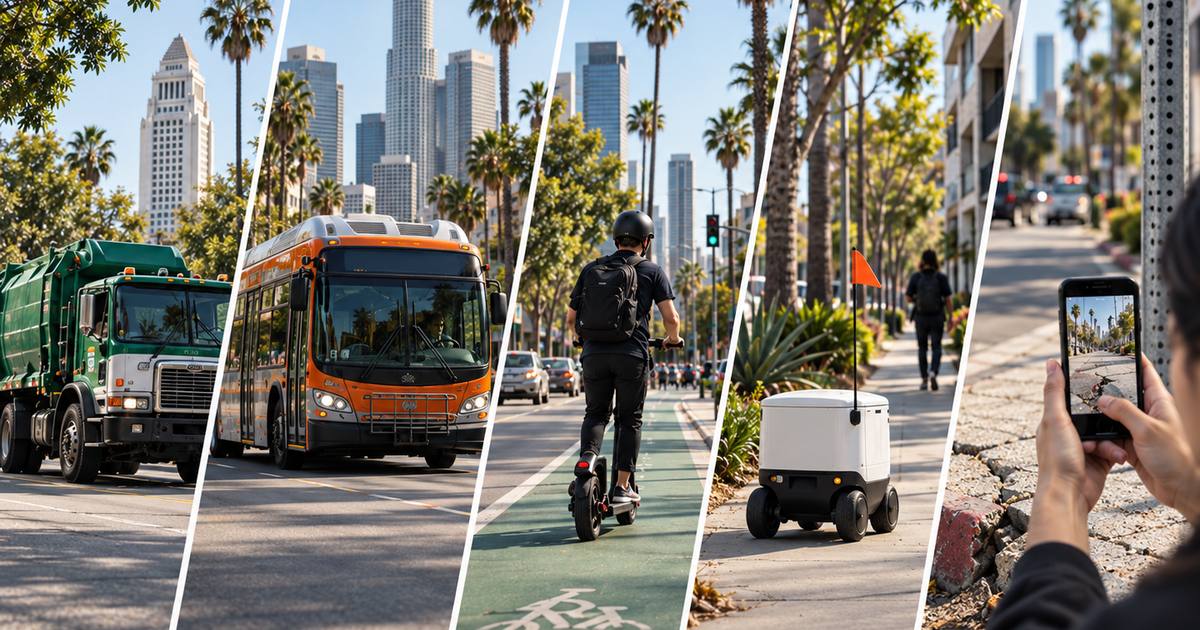
Tea For Streets

The short version
On the street now
- Sidewalk robots
- About 5,000 nationwide: Serve, Coco, Starship, Robot.com, Avride. Roughly 800 in Los Angeles.
- Robotaxis
- 4,000-plus Waymo vehicles in 14 cities. Zoox charges fares in Las Vegas. Tesla runs small fleets in Austin and a few other metros.
- Trucks
- 440,000 driverless miles by Aurora on 10 Sun Belt routes as of June, including a 1,000-mile Fort Worth to Phoenix run.
- Air
- Drone delivery in Dallas-Fort Worth and metro Atlanta. Air taxis are flying test corridors, not passengers.
What stops them
- The sidewalk
- Lifted slabs, missing ramps, construction. The same joints that stop a wheelchair.
- People
- Kicked, tipped and petitioned. Chicago, Glendale, and three cities with outright bans.
- Rules
- A patchwork of state laws, city permits, fleet caps and fees that changes at every city line.
- Systems
- One substation fire froze about 1,600 robotaxi trips in San Francisco last December.
- The forecast: Goldman Sachs sees the US robotaxi market going from about $3 billion next year to $19 billion in 2030. Analysts expect 8,000 delivery robots within three years, and Coco alone says it is tooling up to build 1,000 a month.
- The move: the fleets already map the sidewalk better than most cities do. The useful response is not a ban or a welcome mat. It is asking for the map, fixing the choke points it shows, and keeping residents in the same queue.
Who is on the street right now?
Start on the sidewalk, where the counts are smallest and the contact with people is closest. Serve Robotics, the Uber spinout that trades on Nasdaq, has built more than 2,000 robots and reported 792 daily active robots in the second quarter of 2026, delivering for more than 4,000 restaurants. More than 500 of them work 40 Los Angeles neighborhoods, up from two neighborhoods in 2023. Coco Robotics, which started as a UCLA dorm room project and is headquartered in Venice, runs about 1,000 robots across Los Angeles, Chicago, Miami, Jersey City, Helsinki and Turku, roughly 300 of them in Los Angeles, and has passed 500,000 deliveries. Its new Coco 2 carries front-facing lidar and Nvidia hardware, and the company said it would ramp to 1,000 units a month this summer. Starship Technologies, the Estonian company that pioneered the category, has more than 3,000 robots and 10 million deliveries, most of them on college campuses and in European towns; its US expansion with Uber Eats is planned for 2027. Robot.com, formerly Kiwibot, works Washington, D.C. and Arlington. Avride works Jersey City and Dallas. Add it up and the analyst estimate reported this month, about 5,000 robots delivering nationwide, looks right.
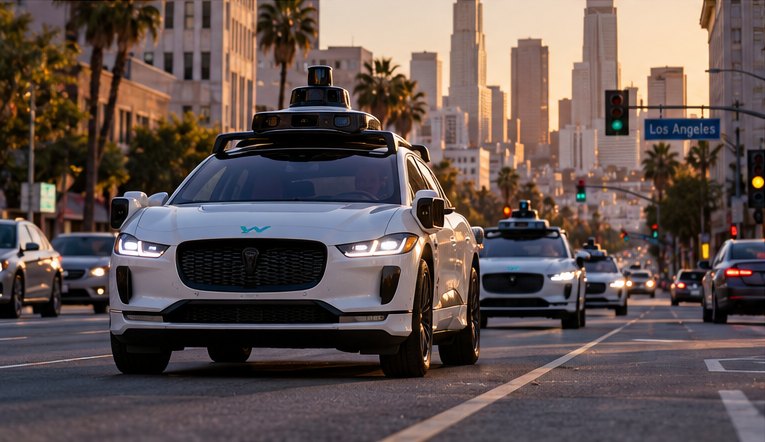
The road is a different scale. Waymo runs more than 4,000 vehicles in 14 US cities, Los Angeles among them, gives more than 500,000 paid rides a week, and had driven 271 million miles with nobody behind the wheel through June. On September 1 it opened San Diego, Tampa and Denver. Zoox, owned by Amazon, charges fares only in Las Vegas and gives free rides in San Francisco. Tesla runs a small robotaxi fleet in Austin and a few other metros, most of it still with a safety monitor aboard. On the highway, Aurora began hauling freight in Texas without a driver in 2025 and had completed nearly 440,000 driverless miles by the end of June on 10 routes across the Sun Belt, including a 1,000-mile run from Fort Worth to Phoenix that no human driver could legally make in one shift.
Overhead is still mostly promise. Wing flies drone deliveries for Walmart in Dallas-Fort Worth and metro Atlanta. Joby flew a week of test corridors over the Dallas area this fall under a federal pilot program and is aiming for its first passenger flights in Dubai by the end of the year. Archer is the official air taxi provider for the 2028 Games and is planning Los Angeles vertiports, including one downtown. Nobody is carrying a paying passenger in a US city yet.
Los Angeles is the clearest case of what saying yes early looks like. In June 2021 the City Council voted 10 to 5 to build a pilot program around the roughly 35 devices Kiwibot and Coco were already running in San Pedro and Venice. In 2022 it wrote rules and handed permits to LADOT. In 2026 the city has the largest sidewalk robot population in the country, a commercial robotaxi service, and a Council motion asking LADOT to go back and study what the robots are doing to pedestrians and accessibility. That is not a contradiction. It is what a pilot is for.
Where is this headed?
The forecasts describe a race, not a finish line. Goldman Sachs Research puts the US robotaxi market at about $3 billion in 2027, $19 billion in 2030 and $48 billion in 2035, inside a global market it sizes at $415 billion. Waymo wants a million paid rides a week by the end of 2026. On the sidewalk, the analysts quoted by the New York Times expect about 8,000 delivery robots within three years and an industry worth more than $5 billion in the US; Transforma Insights expects more than half a million delivery robots worldwide by 2035. Coco has talked about 10,000 robots, Starship about 12,000 by 2027.
The counterweight is the ledger. Serve lost $64 million in the second quarter on $3.2 million of revenue, cut its full-year guidance after Uber Eats volume came in low, and chose not to add robots to its fleet in the first half of the year, focusing instead on revenue per robot. Advertising on the robots’ sides is now almost half of its food delivery revenue. Robotaxis have the opposite problem: the demand is proven and the unit economics are not yet public. The fleets will grow. How fast depends on whether a $1 delivery and a $20 ride can carry the hardware that makes them.
What will actually be outside, in order of how close it is:
Sidewalk and bike-lane robots
Forty to 220 pounds, walking speed, carrying food today and groceries, prescriptions and laundry next. The new generation is built to leave the sidewalk: Coco 2 is designed for bike lanes and road shoulders in cities that allow it.
Robotaxis
Four thousand pounds of sensors and redundancy. Waymo is commercial in Los Angeles, San Francisco, Phoenix, Austin, Atlanta and more; Zoox and Tesla are behind it. The curb, where pick-ups and drop-offs compete with deliveries and parking, is where cities will feel them.
Driverless trucks
Sun Belt highways first, terminal to terminal, with a manufacturing partner tooling toward 1,000 Aurora trucks a year. City streets are the last mile they still hand to a person.
Drones and air taxis
Federal airspace, so cities govern noise and landing sites rather than flight. Drone delivery is routine in parts of Texas and Georgia. Air taxis are flying corridors and certification flights, with Los Angeles vertiports planned for the 2028 Games.
Robots whose job is the street
Irvine hired a consultant whose robots are surveying about 9,000 curb ramps and 950 miles of sidewalk for the city’s ADA self-evaluation, measuring width, cross-slope and ramp geometry with survey-grade positioning. Cleaning and inspection robots are next. These are the first robots on the street whose product is the street itself.
What stops a robot?
Five things, and the first one is concrete.
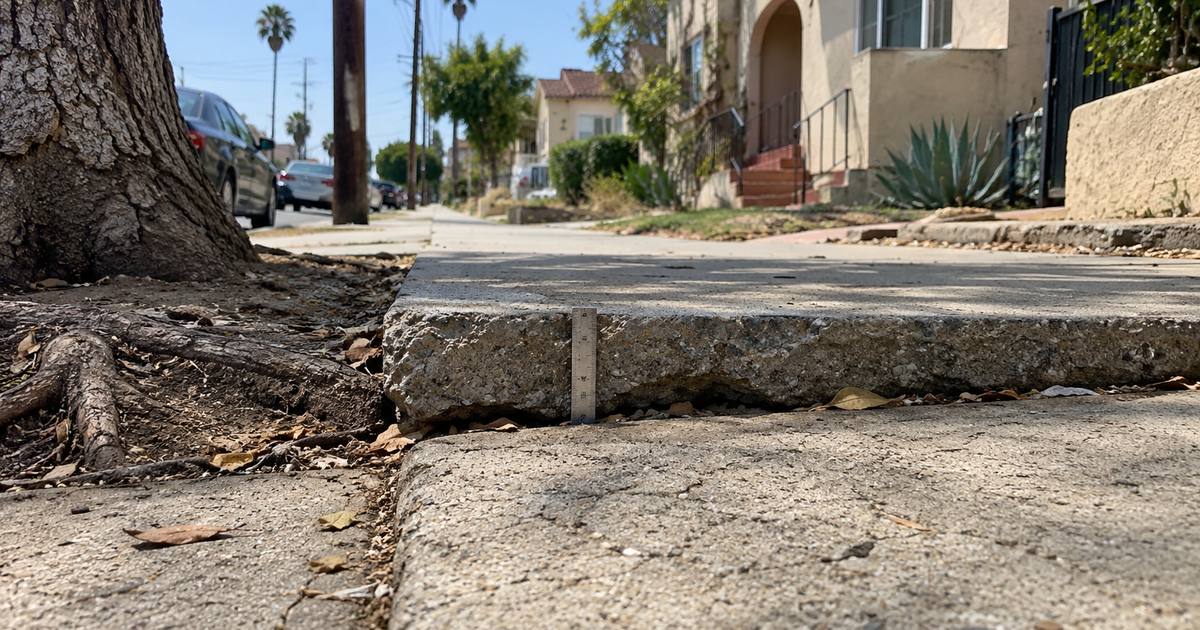
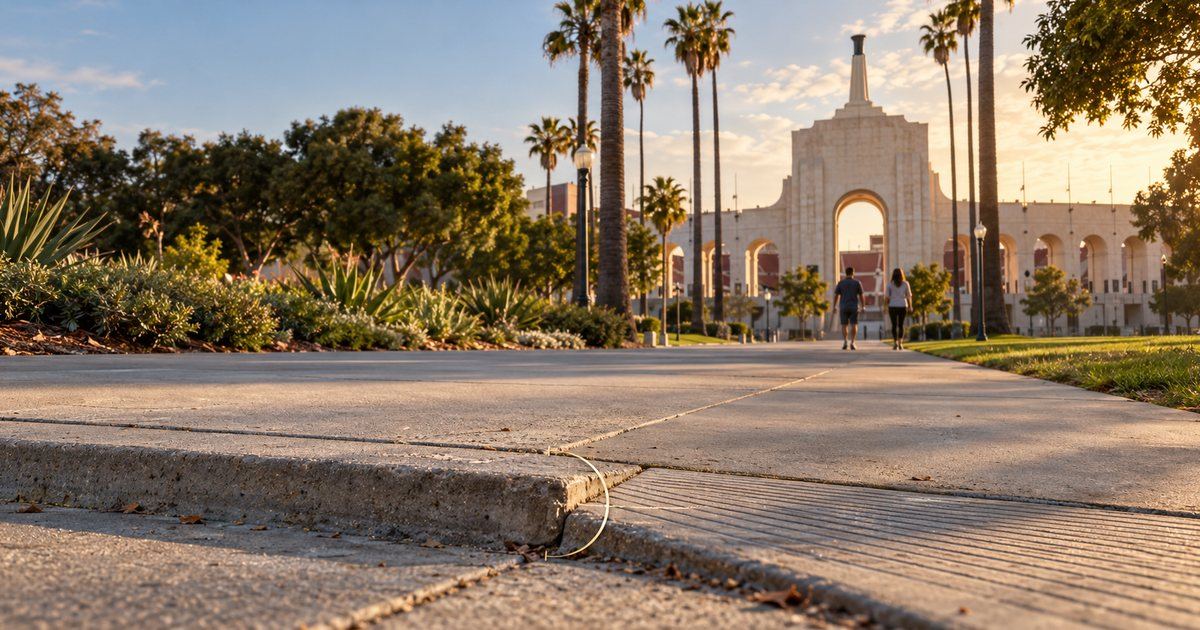
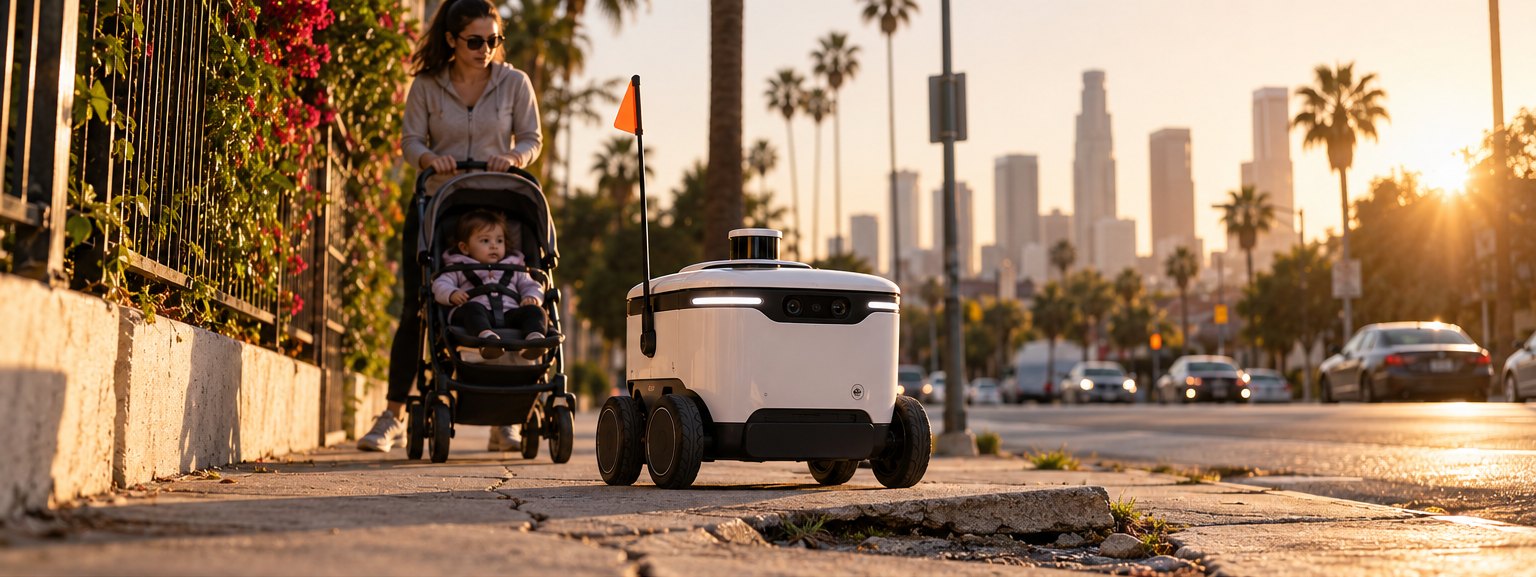
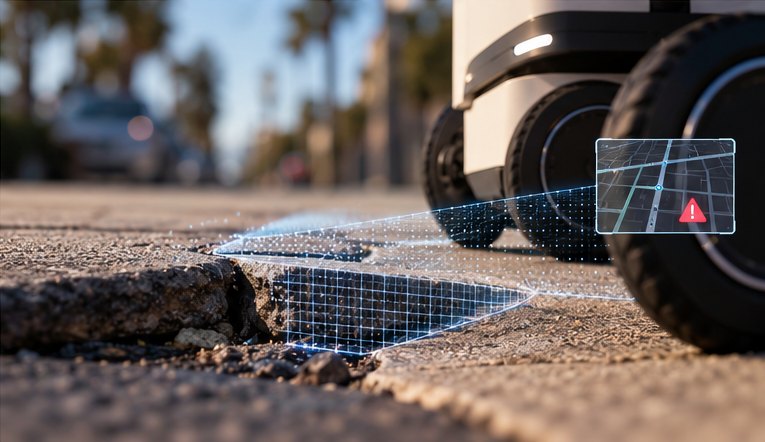
The sidewalk. Coco’s own description of its new robot includes the honest line: damaged sidewalks or unexpected construction can stop a bot in its tracks. Its hardest market is not downtown. It is Abbot Kinney Boulevard in Venice, where old sidewalks with 14-inch curbs and missing curb cuts turn blocks into islands for anyone in a wheelchair, anyone pushing a stroller, and every robot. Camron Bridgford of Cityfi, who ran a four-city sidewalk robot pilot in 2021, told Next City that missing sidewalks, poor curb ramps and maintenance issues were the biggest structural barriers the program hit, and that residents at community meetings asked why the city was worrying about robots when their kids could not walk to school on the broken sidewalk. In Los Angeles that backlog has a number: more than 4,400 sidewalk repair requests waiting, across more than 9,000 miles of public sidewalk, ten years into the $1.37 billion Willits settlement. The City has spent more than $370 million and met its obligation every year; the Bureau of Street Services budget still fell 26 percent between fiscal 2024 and 2026, and sidewalk injury claims cost the City $110 million between mid-2019 and the end of 2025. A robot stalls at exactly the joint that produces those claims. See Why do sidewalk repairs in Los Angeles take so much longer than potholes?
People. The robots are, by design, cute, and in daylight they are also in the way. In Chicago, more than 4,300 people signed a petition to pause the sidewalk robot program by April, and over a quarter of them filed incident reports: collisions, injuries, robots blocking wheelchairs and strollers. One man stumbled into the flag a robot carries at eye level and needed stitches; an alderman blocked further expansion in his ward after overwhelming feedback. In Miami a transportation consultant eating dinner watched two robots meet nose to nose on the sidewalk and sit there until one backed out, and in January a robot rammed a 15-story building and shattered a window, which a police dispatcher logged with the note that the robot was still on the scene. In East Hollywood a robot snagged a homeowner’s fence and dragged it down the street. Robots have smashed a glass bus shelter in Chicago and stalled in a West Hollywood flood while people filmed and cheered. The New York Times, reporting in October, counted robots blocking ambulances and clogging walkways, and a year of vandalism in Los Angeles, Miami, Sacramento and Philadelphia: a crowd in Los Angeles encircling and pounding one, three men in Sacramento filming themselves slamming one on a sidewalk for 2.5 million views. The empty Serve robot weighs 220 pounds. Toronto, Knoxville and Jackson, Wyoming have banned sidewalk robots; Glendale’s mayor has proposed a pause. Santa Monica, for its part, says complaints about its 50 to 100 robots are infrequent. Both things are true at once, and the companies know it: Coco had policy staff before it had a Series B.
Rules. More than 20 states have passed laws permitting sidewalk robots, by Serve’s count. Virginia’s was among the first; Georgia raised its sidewalk speed limit this summer and requires a robot to make a sound within six feet of a person. Cities layer their own: Los Angeles sets speed limits, weight caps, ADA-compliant signage and data-sharing requirements in its LADOT permit; Washington, D.C. requires its operator’s sidewalk data as a condition of the permit; West Hollywood rewrote its license with annual fees and penalties for ADA and geofence violations. A robot company now learns a different rulebook at every city line, and so does every resident trying to figure out whom to call.
Systems. On December 20, 2025, a substation fire blacked out a third of San Francisco. Traffic signals went dark, Waymo’s cars treated every intersection as a four-way stop and asked remote staff to confirm, the remote staff were overwhelmed, and the cars froze: nearly 1,600 stoppages and 64 vehicles that had to be retrieved by hand, some of them in the way of first responders while 911 dispatchers sat on hold with the company. Two Rutgers researchers who studied the episode for the National Academies’ journal call it the monoculture problem: same software, same failure, all at once, with no governance analogue in surface transportation.
Money. See above. The robots that stay on the street will be the ones whose economics close, and in West Hollywood part of that math now runs through the sidewalk: Serve and Coco share advertising revenue with the city at $4 per robot per day, and the fees and fines go into a fund for accessibility improvements, an estimated $40,000 to $80,000 a year. It is the first program of its kind. It will not be the last.
What do robots see that the city does not?
The sidewalk, continuously. A delivery robot has to know the height of every curb and the location of every obstruction to survive, so every fleet builds a map of them whether or not anyone asks. Coco’s head of government relations, Carl Hansen, told Fortune that when the company arrives in a new city and asks what sidewalk mapping data it has, the answer is usually maps that have not been updated in a long, long time. Coco’s map is updated to the minute. An obstacle gets a category and a lifespan: a tipped scooter stays for six hours, active construction for a week, and a structural problem stays on the map permanently, until the city fixes it. Since April that map has fed BlindSquare, the navigation app used by blind pedestrians, which turns it into spoken warnings ten meters before a hazard.
Robot.com’s program in Washington, D.C. and Arlington logged about 35,000 sidewalk data points last year, typed and rated by severity, including the dips and heaves that matter under the ADA; the District requires the feed as a condition of operating. More cities now take robot location data through the Mobility Data Specification, the same pipe Los Angeles built for scooters. Serve shares maps of curb cuts and of intersections that require pressing a button to cross before it enters a city, and Nvidia, whose chips run its robots, says the fleet logs about a million miles of sidewalk data a month. Next City’s reporting found one exception to the rule that cities are not yet using any of it: three curb ramps on Abbot Kinney, which Coco’s routing analysis identified as the choke points that would make the whole neighborhood passable. The company took the finding to the council office, the council office took it to the departments, and the City built the ramps.
Two things about that story are worth holding onto. The first is where the map came from. The positioning system Coco’s robots now use in dense neighborhoods was trained by Niantic Spatial on 30 billion street-level photos that Pokémon Go players took with their phones. The robots did not build the map of the city; people with phones did, and the robots navigate on it. The sensors are not exotic either. The depth sensor on a Coco 2 is a lidar; the depth sensor on a Pro iPhone is a lidar. The difference between a fleet and a resident is frequency and intent, not hardware.
The second is what a city gets if it asks. Los Angeles has never had a complete inventory of its sidewalk conditions; the Controller said so in 2021, and Caltrans just spent two years piloting lidar to learn how to build one for its own sidewalks. A fleet that passes the same joint several times a day, and has to know its height to keep working, is the most frequent sidewalk observer any city has ever had. The condition of the sidewalk is also the one thing on which the robot’s business, the resident’s knee and the City’s liability all agree. See Do cities need LiDAR to know what is wrong with their streets?
That is also the line that keeps this from becoming the surveillance fight it could become. Residents in Chicago called the dataset the robots are compiling massive and growing, and they were right to ask about it. The useful part of what a robot sees is conditions: concrete, curbs, construction, scooters on their sides. The Rutgers authors point out that a city can write limits on what a robot may retain about the people it passes straight into the permit, and we think it should. Observation of the street, not of the people on it, is the whole deal.
What should a city ask of the robots?
Four things, none of which require a new law.
- STEP 01
Ask for the sidewalk, not just the robot.
Location feeds tell a city where the robots are. The permit should also ask for what they found: obstructions, heaves, missing ramps, blocked crossings, typed and rated, anonymized, in a standard the city can load. D.C. already does this. Write a retention limit for anything about people into the same clause.
- STEP 02
Fix the choke points the data shows first.
Abbot Kinney needed three ramps, not thirty. A routing map that knows where the islands are tells a city which repairs open the most blocks per dollar. That is a better list than the order the complaints came in.
- STEP 03
Name one desk and publish the numbers.
A single point of contact for robot incidents, a public registry of who is permitted where, and published incident data. The robot companies would rather answer one desk than twelve, and residents would rather know whom to call than kick the thing.
- STEP 04
Keep the residents in the same queue.
Robots cover delivery blocks. Residents cover everything else, and can say what they are looking at. A robot’s detection and a resident’s report of the same slab should land as one case with one number through the 311 system the city already runs, with a closure someone goes back to check. That is the loop. See Why should cities track outcomes instead of counting submissions?
Cities have absorbed stranger machines than these. A century ago automobiles were called devil wagons and a Georgia court classed them with ferocious animals; it took decades to invent the stop sign. Robots are smaller, slower and far less lethal, and the pattern is the same: a new agent shows up in shared space, the norms wobble, and the cities that write clear rules and ask good questions get the benefit first.
If you run a city department, a Business Improvement District, or a robot fleet and want to see what one block’s record looks like when the robot’s map, the resident’s report and the City’s closure sit in the same place, email us. The first block is on us.